





🎧 Listen: Parenting for Life, Session 4
Richard Harasick · Grace Community Church · 10/11/2009Open Session 4 on gracechurch.org · Download MP3
Richard Harasick · Grace Community Church · 10/11/2009Open Session 4 on gracechurch.org · Download MP3
Lesson 4
The Parent’s Roles
Teach, nurture, correct and equip
Source status: These lesson pages are original study-based adaptations of the Parenting for Life themes. They are not transcripts or official course notes. The Lesson 4 audio has not yet been transcribed. Scripture is quoted from the NASB 1995; read every passage in context.
Lesson opening
God gives parents real responsibility for their children, and with it real accountability to Him. This lesson looks at what that role involves: teaching before correcting, disciplining with purpose rather than anger, looking beneath the surface to the heart, and preparing children for growing responsibility.
Scripture reading
Read: Ephesians 6:4; Colossians 3:21; Proverbs 4:23; Proverbs 13:24; Proverbs 22:15; Proverbs 23:13-14; Proverbs 29:15; Hebrews 12:10-11; Galatians 6:1
“Watch over your heart with all diligence, For from it flow the springs of life.”Proverbs 4:23 (NASB 1995)
“He who withholds his rod hates his son, But he who loves him disciplines him diligently.”Proverbs 13:24 (NASB 1995)
“Foolishness is bound up in the heart of a child; The rod of discipline will remove it far from him.”Proverbs 22:15 (NASB 1995)
“The rod and reproof give wisdom, But a child who gets his own way brings shame to his mother.”Proverbs 29:15 (NASB 1995)
“All discipline for the moment seems not to be joyful, but sorrowful; yet to those who have been trained by it, afterwards it yields the peaceful fruit of righteousness.”Hebrews 12:11 (NASB 1995)
Teaching
Parents are entrusted with responsibility
Parents are neither passive spectators nor absolute rulers. They have a responsibility to protect, teach, model, correct and prepare children for increasing responsibility. Authority should be exercised as stewardship before God, never as permission for humiliation or harm.
Instruction comes before correction
Children need to know what is expected, why it matters and how to practise it. A clear routine, an age-appropriate explanation and a consistent example reduce confusion. When behaviour falls short, respond to the specific action and teach a constructive alternative.
Discipline is loving, controlled and purposeful
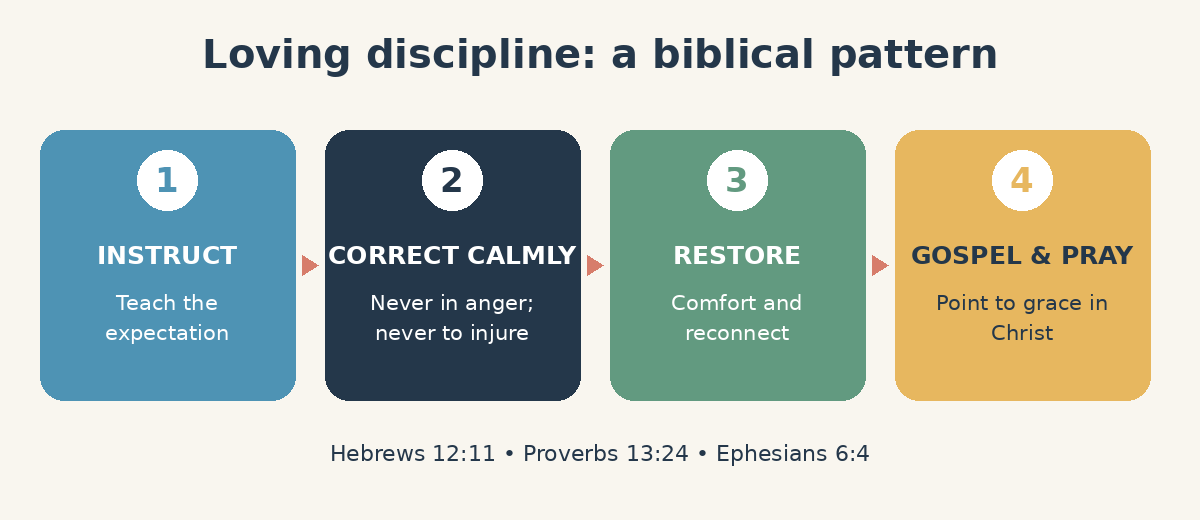
Scripture teaches that a parent who loves a child will discipline him, and that this discipline includes the rod (Proverbs 13:24; 22:15; 23:13–14; 29:15). Biblical spanking is never violent, never an outlet for anger, never humiliating and never meant to injure. It is given calmly and privately, only after the child understands what was wrong, and in proportion to the offence. It belongs alongside clear instruction, warnings and other consequences, not in place of them. If you are angry, wait until you are calm. Afterwards, comfort and hold your child, assure them of your love, and point them to the forgiveness God offers in Christ. The goal is the “peaceful fruit of righteousness” (Hebrews 12:11), not revenge or the release of adult frustration.
Look below the surface
The heart diagram in the course appendix illustrates that desires, intentions and beliefs influence outward behaviour. We can use this insight to ask open questions. We should not presume we can read a child’s heart; listen and investigate gently.
Responsibility grows with maturity
The parent–child relationship chart highlights a shift from intensive early guidance towards greater instruction, discernment and responsibility. It is a conceptual picture, not a rigid age-based formula. Continue relationship and counsel while allowing suitable independence.

My reflection
The authority I have as a father is real, but it is borrowed. God has entrusted my children to me, and I will answer to Him for how I use that trust. Ephesians 6:4 holds both sides together: I must not provoke my children to anger, and I must bring them up in the discipline and instruction of the Lord.
I believe Scripture when it says that the parent who withholds the rod does not truly love his child. I cannot hand discipline over to a culture that calls all spanking harmful. But I also know my own heart. I’m tempted to correct before I have clearly taught, and to let my irritation set the tone. A spanking given in anger is not biblical discipline at all.
So I want my discipline to be calm, controlled and never harsh, and I want it always to end the same way: with a hug, with reassurance of my love, and with the gospel. Hebrews 12 reminds me that discipline is training for righteousness.
Proverbs 4:23 points me to the heart. My goal is not just to stop the behaviour but to shepherd my child towards Christ.
Discuss and reflect
- Have I clearly taught the behaviour I expect before I correct?
- Am I correcting to help my child grow, or because I am angry?
- When I use the rod, is it calm, private, never harsh, and always followed by comfort, restoration and the gospel?
- Where can I offer a little more age-appropriate responsibility?
This week’s practice
Choose one recurring area of disobedience. At a calm time, teach the expectation and explain clearly what will follow if your child chooses to disobey, whether a loss of privilege or a calm, controlled spanking. When it happens, follow through consistently and without anger. Afterwards, hold your child, reassure them of your love, talk about forgiveness in Christ and pray together. Recognise progress when you see it.
Closing prayer
Father, thank You for disciplining Your children for our good. Help me to carry the responsibility You have given me with humility and faithfulness: to teach patiently, to discipline with self-control and never in anger, to look to the heart, to restore quickly and to point my children to Christ. Where I have exasperated them, forgive me and help me to make it right. Amen.
Download with this lesson
Parenting for Life: Lessons 1–4 study companion (PDF)
Printable infographic pack, 6 sheets (PDF). The Heart and Behaviour and Growing in Responsibility sheets support this lesson.
Scripture quotations taken from the (NASB®) New American Standard Bible®, Copyright © 1960, 1971, 1977, 1995 by The Lockman Foundation. Used by permission. All rights reserved. lockman.org