



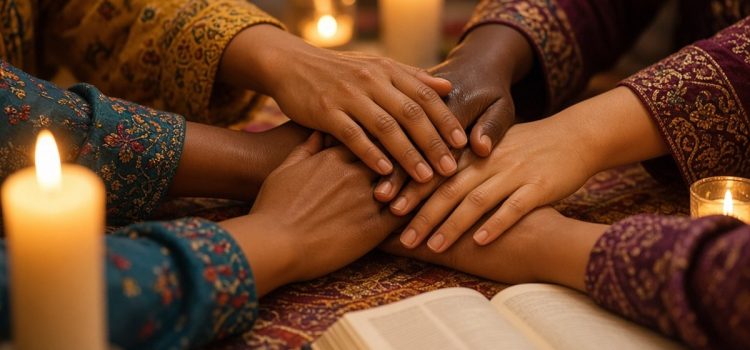
Tomorrow, Sunday 1 November, many churches around the world will set aside time to pray for persecuted Christians. The International Day of Prayer for the Persecuted Church is organised by the World Evangelical Alliance on 1 and 8 November this year. It began in 1994 after the murder of Bishop Haik Hovsepian Mehr in Iran, and this year’s theme comes from 2 Timothy 3:10-12.
I want to share why I think this matters, what has been happening, and how we might pray.
What has been happening
Baptist Press cites an estimated 388 million believers suffering extreme persecution. Todd Nettleton of The Voice of the Martyrs describes the day of prayer as “a practical response to their number one request.” He adds: “I hope every church will ‘Remember those in prison’ (Hebrews. 13:3) during their services this November 1st.”
The Open Doors World Watch List 2026, as reported by Baptist Press, counted 4,849 Christians killed for their faith in the reporting period. 3,490 of them were in Nigeria, on our own continent.
Closer to the present, the Associated Press reported on 27 October that two attacks in Ethiopia’s Oromia region killed about 60 Orthodox Christians: 14 in Merti on 20 October and 46 in Shirka on 24 October. More than 20 people were wounded and about 20 homes burned. A regional spokesperson blamed the Oromo Liberation Army but gave no evidence. The Ethiopian Orthodox Church called the killings “brutal and merciless massacres” (AP via ABC News).
What stood out to me
The first thing is how close this is. When we talk about the persecuted church, South Africans sometimes picture somewhere far away. But Nigeria and Ethiopia are African nations, a few hours’ flight from Johannesburg. Many South African churches welcome believers from both countries, and our cities are full of people with family and friends there.
The second is that Nettleton calls prayer the persecuted church’s “number one request.” Not first money, not first publicity, but prayer. That rebukes my own prayerlessness. I am quick to read the news and slow to bring it to the throne of grace.
The third is that persecution is not strange. Paul told Timothy, “Indeed, all who desire to live godly in Christ Jesus will be persecuted” (2 Timothy 3:12, NASB 1995). The comfort we enjoy in South Africa, with freedom to gather, preach and buy Bibles, is a gift and not a guarantee. And it is a stewardship.
One body
Hebrews 13:3 is the text behind tomorrow: “Remember the prisoners, as though in prison with them, and those who are ill-treated, since you yourselves also are in the body” (Hebrews 13:3, NASB 1995). Notice the words “as though in prison with them.” We are not to pray from a safe distance. We are to pray as people who belong to the same body. “And if one member suffers, all the members suffer with it” (1 Corinthians 12:26, NASB 1995).
What about South Africa?
It would be wrong to claim that South African Christians are persecuted the way believers in Nigeria or Ethiopia are. We are not. But that should make us more grateful, not more complacent. Freedom is a door God has opened for gospel work. We should use it to preach, to give, to send missionaries, and to stand with brothers and sisters who have no such freedom. One day we may need their prayers as much as they need ours now.
How to pray
- For endurance and faithfulness: that believers in Ethiopia, Nigeria and elsewhere would not deny Christ, and would not be overcome with fear or bitterness.
- For the grieving and wounded: for the families in Merti and Shirka, for orphans and widows, and for those who have lost homes.
- For the church’s witness: that, as so often in history, persecution would become an occasion for the gospel to spread.
- For persecutors: that God would save them, as He saved Saul of Tarsus.
- For governments: that leaders would protect the innocent and bring killers to justice.
- For ourselves: that we would not waste our freedom, and that we would be ready to suffer if called to.
Learn – Grow – Change
- Learn: Read 2 Timothy 3:10-12 and Hebrews 10:32-34. Notice how the early church responded to suffering.
- Grow: Choose one country from the World Watch List and pray for it by name every week this month.
- Change: If your church is not marking the day tomorrow, pray for the persecuted church with your family over Sunday lunch.
They are our brothers and sisters. Let us remember them, as though in prison with them.